
APPLICATIONS
Reliable oil ingredients supporting pet food formulation, palatability and production needs.
Which pet food oils best support omega-3 claims in dog diets?
For dog diets that need a credible omega-3 position, oils supplying preformed EPA and DHA are usually the strongest choice. Fish oil is the practical benchmark for most formulations because it can contribute both fatty acids directly. Algal oil can serve the same nutritional purpose where a marine-fish ingredient is unsuitable, while plant oils are more limited because they mainly provide ALA, which dogs convert inefficiently to EPA and DHA.
The first decision is therefore not simply which oil contains the highest total omega-3 number. It is whether the intended claim, nutritional target, and feeding format require EPA and DHA specifically. A formula positioned around skin, coat, joint, cognitive, or life-stage support will generally need a source whose fatty-acid profile supports that position directly.
Fish oil remains the most versatile option
Fish oil is often the first option technical teams assess because it delivers EPA and DHA in a familiar format for dry food, wet food, toppers, and supplements. It can support a clear omega-3 formulation story without relying on biological conversion from shorter-chain fatty acids.
However, “fish oil” is not a sufficient specification. EPA and DHA concentration can vary substantially by raw material, refining approach, and blending practice. An evaluator should request a current fatty-acid profile rather than qualify an oil only by species description or total omega-3 content. The useful figure is the delivered EPA plus DHA at the intended inclusion rate after accounting for process and shelf-life losses.
Oxidation control deserves the same weight as fatty-acid concentration. Oils rich in long-chain polyunsaturated fatty acids are inherently more sensitive to oxygen, heat, light, and metal contamination. An oil with an attractive initial EPA/DHA value may be a weak choice if peroxide value, anisidine value, storage handling, packaging, or antioxidant strategy are poorly controlled. This becomes especially important for extruded kibble, where the oil may be applied after cooking but still needs to remain stable through packaging and distribution.
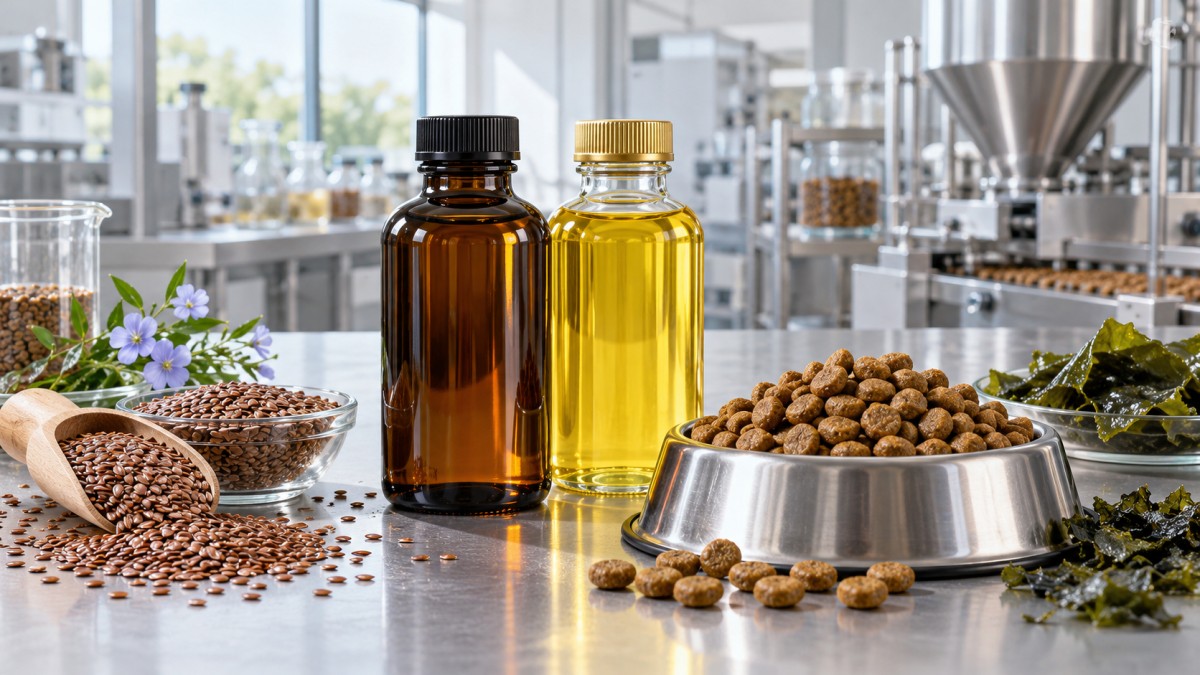
Algal oil is useful when formulation constraints rule out fish oil
Algal oil can supply DHA and, depending on the material, EPA as well. It is particularly relevant when a brand requires a non-fish marine omega-3 source, seeks a more tightly defined ingredient origin, or needs to avoid fish-related positioning concerns. Its use should still be evaluated on the actual EPA and DHA specification rather than the broad label “algal oil.” Some products are heavily DHA-focused and may not provide enough EPA for a formulation designed around both fatty acids.
For dog diets, a DHA-focused algal oil can be a logical fit where DHA is the primary nutritional objective, such as selected puppy, breeding, or senior formulations. A broad adult-dog omega-3 claim may call for a more balanced EPA/DHA supply. In that case, formulators should determine whether an algal material alone meets the target or whether a blend is needed.
Cost and processing compatibility also matter. Algal oils can have different sensory characteristics, physical behavior, and dosage requirements from conventional fish oils. Palatability validation should be part of qualification, particularly when the oil is used at a meaningful inclusion level or when the product already contains other high-impact ingredients.
Plant oils support omega-3 content, but not every omega-3 claim
Flaxseed, chia, canola, soybean, and similar oils can contribute ALA. They may be appropriate where a formula needs a plant-derived omega-3 component, a balanced omega-6-to-omega-3 profile, or a complementary fatty-acid source. They should not automatically be treated as substitutes for fish or algal oil when the intended nutritional proposition depends on EPA and DHA.
Dogs can convert ALA into longer-chain omega-3 fatty acids, but the conversion is limited and variable. A high ALA number therefore does not establish equivalent EPA or DHA delivery. This distinction matters in both product development and claim review. If the product contains only plant omega-3 sources, the wording should accurately reflect that composition rather than implying a level of EPA/DHA support the formula does not provide.
- Use fish oil when direct EPA and DHA delivery, broad nutritional relevance, and formulation flexibility are priorities.
- Use algal oil when fish-free marine sourcing or DHA-focused nutrition is required, provided the EPA/DHA profile fits the claim.
- Use plant oils when ALA is sufficient for the product concept or when they are intended to complement, rather than replace, long-chain omega-3 sources.
Evaluate the oil in the finished diet, not only in the supplier specification
Pet Food Oils should be assessed as part of the complete manufacturing system. The relevant questions include whether the oil will be mixed into the batch, incorporated before thermal processing, sprayed onto kibble, or packed in a liquid product. Each route changes exposure to heat and oxygen. Antioxidant selection, tank turnover, nitrogen blanketing where applicable, packaging barrier properties, and lot traceability can materially affect the final omega-3 value.
A sound approval process should compare EPA, DHA, total omega-3s, oxidation indicators, sensory impact, physical handling, and batch-to-batch consistency. It should also define acceptance limits that reflect the product’s end-of-shelf-life target, rather than accepting an oil solely because it meets a fresh-delivery specification.
For most dog-food programs, fish oil is the clearest route to a robust EPA/DHA-based omega-3 claim. Algal oil is the principal alternative when its fatty-acid balance matches the nutritional objective. Plant oils remain useful ingredients, but their role should be evaluated honestly: they provide ALA, not a direct replacement for the EPA and DHA that many omega-3 claims are intended to communicate.
Related Posts
- ▶ Which pet food oils best support omega-3 claims in dog diets?
- ▶ How pet food fats affect kibble texture after extrusion
- ▶ When do pet food oils become rancid during storage?
- ▶ How to compare pet food fats and oils by energy density
- ▶ What to check when sourcing pet food ingredients with added oils
- ▶ Can coating with pet food oils improve dry food palatability?