
APPLICATIONS
Reliable oil ingredients supporting pet food formulation, palatability and production needs.
Can coating with pet food oils improve dry food palatability?
Yes. A well-controlled oil coating can make dry kibble more appealing by carrying aroma compounds, increasing surface flavor, and changing the first sensory contact when a pet takes a bite. The result is not determined by oil addition alone. Coating performance depends on where the oil sits on the kibble, how evenly it is applied, its freshness, and how it interacts with digest, palatants, and the base recipe.
Dry kibble leaves the extruder with a porous structure and relatively low surface fat. Applying Pet Food Oils after drying allows flavor-bearing lipids to remain near the exterior instead of being exposed to the highest extrusion temperatures. This often produces a more immediate aroma when the package is opened and a stronger surface signal during eating. A coating can also reduce dusty handling and give kibble a more finished appearance, although excessive surface oil may create greasy pieces, poor flow, or package staining.
Why surface placement changes acceptance
Palatability is influenced by smell before eating and by flavor release, mouthfeel, and texture during chewing. A coating layer supports all four, but each responds differently. Volatile aroma compounds need to be retained through storage and released when the bag is opened. Fat-soluble flavor materials need adequate oil coverage to reach the surface consistently. Texture changes when oil penetrates into pores or softens the outer structure, which can be desirable for some recipes but can reduce the intended crunch if carried too far.
Oil type also affects the sensory profile. Different animal and marine-derived fats have distinct odor notes and melting behavior. A liquid oil spreads readily in a coater but may migrate more easily during warm storage. A more solid fat can stay on the surface better at ordinary temperatures, yet it needs suitable heating and atomization to avoid uneven droplets. The desired choice follows the product's aroma target, expected storage conditions, and the coating equipment rather than a single universal preference.
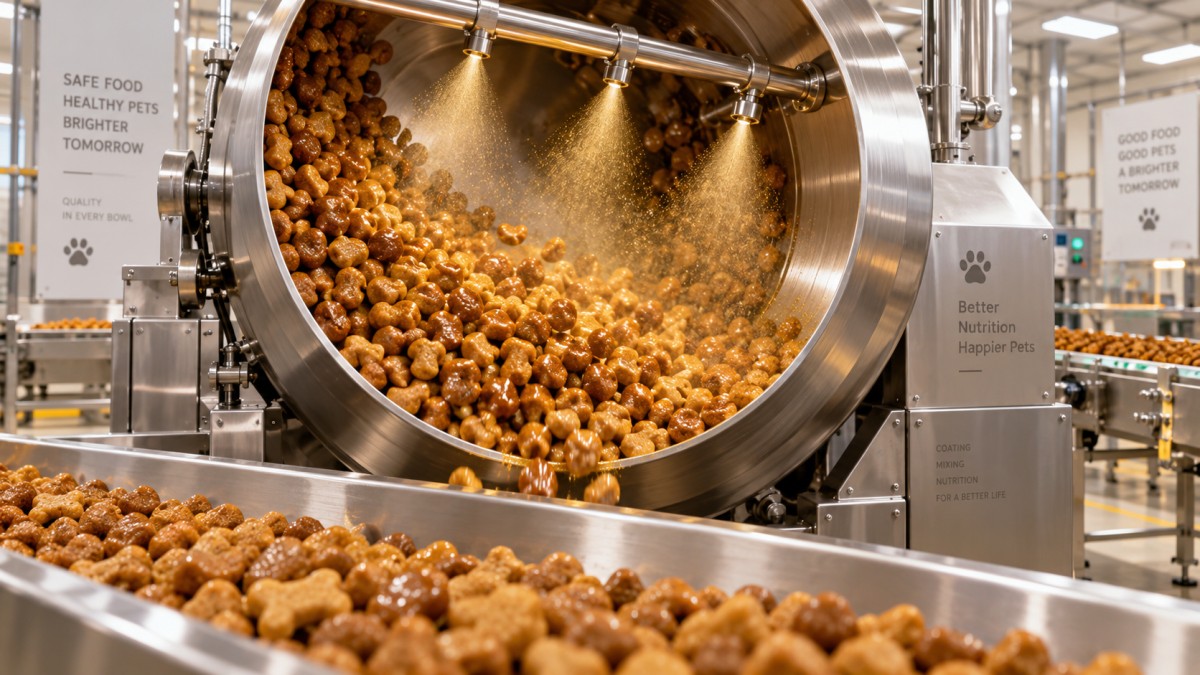
Coating conditions that affect the result
Uniform distribution is often more important than simply increasing the oil level. When some pieces receive too little coating and others become saturated, a bowl can contain noticeably different sensory experiences. Uneven coverage can stem from incorrect spray pattern, insufficient drum mixing, changes in oil temperature, clogged nozzles, or inconsistent kibble size and porosity.
- Kibble temperature: A warm substrate can help the oil spread and enter surface pores. If it is too warm, the coating may absorb too quickly, leaving less flavor on the exterior.
- Oil viscosity: Viscosity changes with temperature and composition. Thick oil can form large droplets; oil that is too thin may run off before it distributes across the tumble bed.
- Application order: Oil is frequently used as a carrier before or alongside powdered palatants. Adding powder without sufficient adhesion can produce loose fines, while too much oil after powder application can mute the intended surface flavor.
- Residence time: The kibble needs enough movement for coverage to equalize, but prolonged mechanical handling can chip fragile pieces and generate fines.
Freshness is part of palatability
An oil coating may initially smell attractive yet lose appeal when oxidation develops. Oxygen exposure, heat, light, metal contact, and repeated warming can accelerate deterioration. The issue is not limited to an unpleasant odor: oxidation can change the flavor of the coating and make batch-to-batch sensory results difficult to interpret. Storage practices therefore matter alongside the oil specification. Closed, clean transfer lines, controlled tank conditions, appropriate stock rotation, and prompt investigation of unusual odor or color changes reduce avoidable variation.
Bulk oil should also be sampled and evaluated in the same form in which it will be used. A sample that appears acceptable at room temperature may behave differently after warming for spraying, blending with palatants, or remaining on kibble through packaging and warehouse storage.
Evaluating whether the coating is working
Acceptance testing should compare complete coated kibble samples, not oil in isolation. A highly aromatic oil can appear promising in a container but perform poorly when it is absorbed into a dense kibble or covered by a competing digest layer. Conversely, a modest aroma may perform well when it creates even coverage and supports the formula's existing flavor profile.
Useful evaluation includes visual inspection for dry spots and pooling, assessment of coating pickup across the batch, odor checks at production and after retained storage, and controlled feeding observations using comparable kibble size and moisture. When acceptance changes, separating coating uniformity, oil condition, palatant adhesion, and base-kibble texture prevents a misleading conclusion that the oil itself is the sole cause.
Coating with pet food oils can therefore improve dry food palatability, provided the oil is fresh, compatible with the formula, and applied under conditions that create stable, even surface coverage.
Related Posts
- ▶ Which pet food oils best support omega-3 claims in dog diets?
- ▶ How pet food fats affect kibble texture after extrusion
- ▶ When do pet food oils become rancid during storage?
- ▶ How to compare pet food fats and oils by energy density
- ▶ What to check when sourcing pet food ingredients with added oils
- ▶ Can coating with pet food oils improve dry food palatability?