
APPLICATIONS
Reliable oil ingredients supporting pet food formulation, palatability and production needs.
What to check when sourcing pet food ingredients with added oils
For pet food ingredients with added oils, the lowest quoted price is rarely the lowest total cost. A cheaper material can create higher losses through rancid odour, uneven coating, reduced palatability, rejected batches, or a shorter finished-product shelf life. The purchase decision should start with how the ingredient will be processed and stored, then move to oil quality, documentation, and supply consistency.
Check whether the oil suits the actual product process
Ask how the ingredient will be used: mixed into a formula, applied as a coating after extrusion, or included in a moist product. These applications place different demands on the oil system.
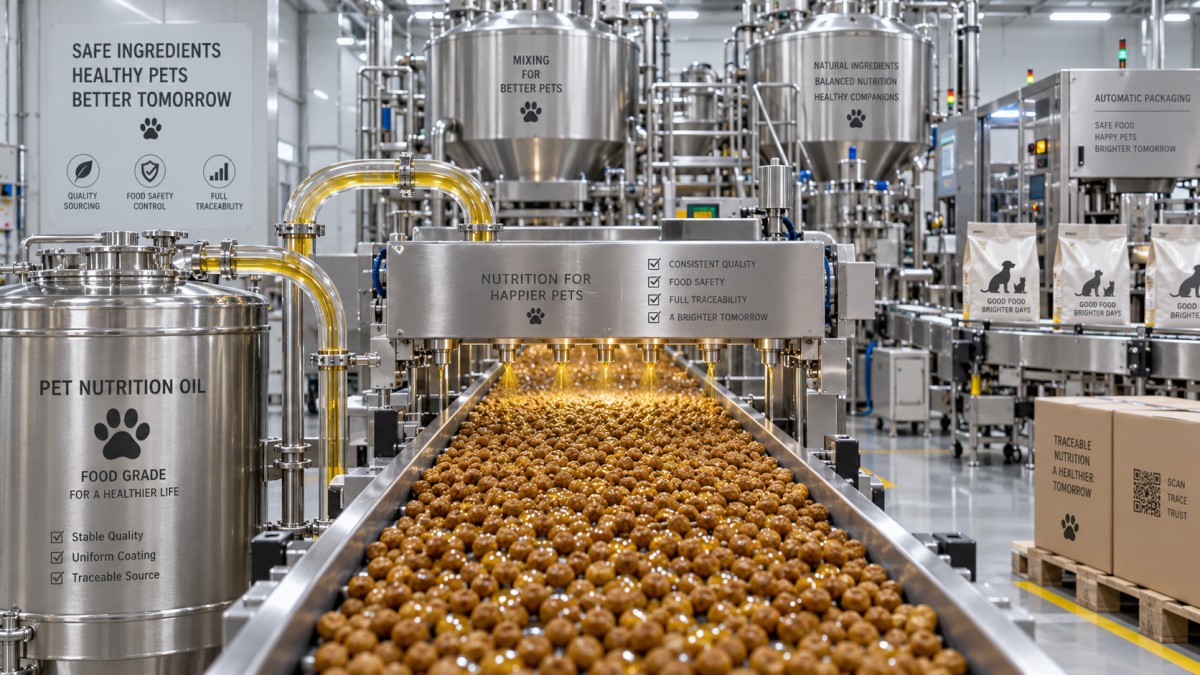
For dry kibble and treats, oxidation resistance is especially important because the product may remain in distribution for an extended period. For coated products, the oil must also apply evenly and remain stable without excessive surface leakage. A material that performs acceptably in a short production trial may still be unsuitable if its odour or appearance changes during normal storage.
Procurement should request a clear description of the added oil, rather than accepting a broad statement such as “animal oil added.” The source, treatment method, expected appearance, and handling requirements affect formulation decisions and finished-product consistency.
Evaluate oxidation risk before comparing price
Oils deteriorate when exposed to oxygen, heat, light, and repeated handling. Once oxidation progresses, an ingredient may develop off-odours and affect the aroma of the finished pet food. This is not only a quality issue: a batch that cannot be used as planned creates disposal, reformulation, and production-delay costs.
Request the supplier’s testing approach for freshness and stability, along with batch-specific quality documents. The documents should be useful for receiving inspection, not merely a generic specification sheet. It is also practical to ask how the material is protected during storage and transport, including packaging type, sealing, and temperature exposure.
Do not assume that a higher oil level automatically means greater risk or better palatability. The relevant question is whether the oil level and condition are consistent from batch to batch, and whether they fit the finished product’s intended shelf life.
Traceability should reach both the base ingredient and the oil
A traceable lot number is necessary, but procurement teams should confirm what it covers. With oil-added pet food ingredients, traceability should connect the incoming raw material, the oil source, the blending or application stage, and the final packed lot.
This makes a quality investigation more manageable if a receiving check, odour change, or customer complaint occurs. It also helps prevent a common sourcing mistake: treating the supplier’s finished specification as the only control point while ignoring variation in the raw materials that feed the process.
Assess supplier control, not just the sample
A retained sample can show what one delivery looks like; it does not prove that the supplier can repeat it. Review how the supplier manages raw-material intake, production hygiene, in-process checks, finished-goods inspection, and non-conforming batches. The useful question is not whether quality control exists, but whether there are clear checkpoints before material leaves the site.
Supplier capacity matters for the same reason. A producer with regular raw-material throughput is generally better positioned to maintain planned supply than one relying on irregular spot purchases. Liaocheng Jinfu Oil Co., Ltd., established in 2012, reports annual raw-material production capacity above 30,000 tons and sales of 18,000 tons, with products supplied mainly to pet food manufacturers. Its three dedicated quality-control staff provide a concrete point for buyers to discuss inspection procedures, lot records, and release criteria.
Calculate delivered cost, not unit price
Compare offers using the usable cost of the ingredient after freight, packaging, expected storage loss, minimum order quantity, and potential rework are considered. A lower-priced material can become less economical when it requires smaller, more frequent orders because of limited stability, or when variable oil content forces formulation adjustments.
- Obtain the specification, a recent batch document, and a representative sample.
- Confirm oil source, consistency, storage conditions, and expected use-by handling.
- Run a process-relevant trial, including odour, handling, coating behaviour, and finished-product appearance.
- Agree on lot identification, complaint handling, delivery frequency, and acceptable batch variation before committing to routine supply.
The most useful first step is to match the ingredient’s oil stability and supplier controls to the real production and distribution cycle. That comparison gives procurement a stronger basis for controlling both ingredient cost and downstream quality risk.
Related Posts
- ▶ Which pet food oils best support omega-3 claims in dog diets?
- ▶ How pet food fats affect kibble texture after extrusion
- ▶ When do pet food oils become rancid during storage?
- ▶ How to compare pet food fats and oils by energy density
- ▶ What to check when sourcing pet food ingredients with added oils
- ▶ Can coating with pet food oils improve dry food palatability?