
APPLICATIONS
Reliable oil ingredients supporting pet food formulation, palatability and production needs.
How to compare pet food fats and oils by energy density
Most edible fats deliver broadly similar gross energy on a dry, pure-fat basis: approximately 9 kcal per gram. That figure is useful, but it is not sufficient for comparing pet food fats and oils in a formulation. The operational question is how much metabolizable energy (ME) the ingredient contributes in the finished diet, at a consistent inclusion rate and with acceptable nutritional, processing, and shelf-life performance.
A technically sound comparison starts by separating the energy value of the lipid itself from the energy value of the commercial ingredient received by the plant. Two fats can both be described as “high energy” while producing different formulation results because of moisture, insoluble impurities, free fatty acids, digestibility, and interactions with the rest of the recipe.
Compare on a usable-energy basis, not on product labels alone
For a simplified formulation estimate, the energy contribution of a fat ingredient can be expressed as:
Ingredient ME contribution = inclusion rate × fat content × digestibility-adjusted energy value
The calculation must use the same basis for every candidate ingredient. If one supplier reports oil at 99.5% fat as received and another reports a rendered fat on a dry-matter basis, their figures cannot be compared directly. Water and non-fat material displace energy. A product with lower moisture and lower insoluble impurities will normally provide more usable energy per kilogram delivered, even where the underlying triglyceride profile is similar.
For finished-food calorie declaration and routine screening, the modified Atwater approach commonly assigns fat 8.5 kcal/g. This is a practical diet-level convention, not a substitute for evaluating a specific raw material’s actual contribution in a particular formula. Internal formulation systems may use supplier data, digestibility evidence, and validated feeding results to refine ME assumptions.
Why nominally similar fats can perform differently
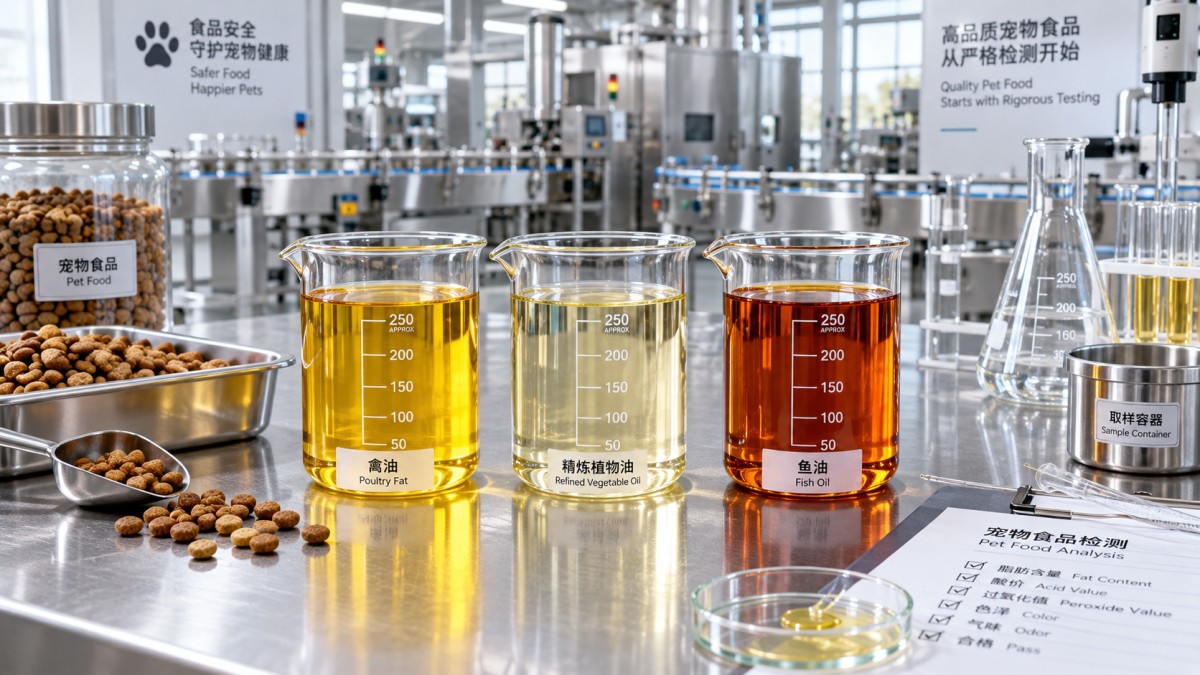
Rendered poultry fat, beef tallow, pork fat, fish oil, and vegetable oils are all energy-dense lipid sources. Their gross energy is not usually the main differentiator. The critical differences lie in the proportion of usable lipid and the conditions under which that lipid is digested and retained in the finished product.
- Total fat and moisture: A refined oil is generally close to pure lipid. A rendered fat with higher moisture, insolubles, or unsaponifiable material contains less energy per delivered kilogram.
- Free fatty acids (FFA): FFA content is not an energy value by itself, but elevated levels can indicate hydrolytic deterioration or inconsistent handling. It should be interpreted with moisture, acid value, odor, and storage history rather than treated as an isolated pass/fail number.
- Fatty-acid profile: Saturated and unsaturated fats both carry high energy, but their melting behavior and digestibility can differ. Highly saturated fats may require greater attention in cold processing conditions or in diets for animals with reduced fat tolerance.
- Oxidative condition: Oxidized oil may still contain calories, but it is not equivalent nutritionally or functionally to fresh oil. Peroxide value alone does not capture all stages of oxidation; anisidine value or other agreed oxidation indicators may be needed where storage exposure is significant.
- Matrix effects: Extrusion conditions, kibble density, starch level, fiber level, coating uniformity, and total dietary fat can alter realized energy intake. An oil that is easily metered and evenly applied can produce more consistent finished-product energy than a theoretically comparable alternative with poor handling behavior.
Energy density should not override fatty-acid function
Selecting only by kcal/kg can create an unbalanced formula. Linoleic acid, alpha-linolenic acid, EPA, and DHA have functions beyond energy supply. Fish oil, for example, may be chosen to deliver long-chain omega-3 fatty acids, not because it offers materially more calories than another clean oil. Poultry fat may support palatability and provide a different fatty-acid pattern, while certain vegetable oils can be useful where a higher linoleic acid contribution is required.
The relevant comparison is therefore not “which oil has the highest energy,” but “which ingredient supplies the required usable energy after its nutritional constraints are met.” Once essential fatty-acid targets and maximum inclusion limits are established, the remaining energy gap can be filled with the most stable and process-compatible option.
Use specification limits that relate to formulation risk
A purchasing specification should state more than a minimum crude-fat percentage. For energy-density control, it should define the reporting basis and acceptable limits for moisture, insoluble impurities, and relevant quality indicators. Batch-to-batch variation matters because a small change in non-fat content becomes meaningful when oil is used at high inclusion levels or when coating rates are tightly controlled.
Incoming verification should also consider temperature at delivery, filtration condition, tank turnover, and traceability. A fat that meets a compositional specification but arrives partly solidified, poorly filtered, or near the end of its oxidation life can disrupt application rates and weaken the expected energy consistency of the diet.
A practical decision rule
Rank candidate pet food fats and oils first by normalized ME per kilogram of delivered ingredient, then test whether that ranking remains valid after fatty-acid requirements, oxidation limits, palatability targets, and plant handling constraints are applied. The preferred source is rarely the one with the highest theoretical caloric value. It is the source whose usable energy is predictable, whose quality remains stable through storage and processing, and whose nutritional profile fits the formula without creating compensating risks elsewhere.
Related Posts
- ▶ Which pet food oils best support omega-3 claims in dog diets?
- ▶ How pet food fats affect kibble texture after extrusion
- ▶ When do pet food oils become rancid during storage?
- ▶ How to compare pet food fats and oils by energy density
- ▶ What to check when sourcing pet food ingredients with added oils
- ▶ Can coating with pet food oils improve dry food palatability?