APPLICATIONS
Reliable oil ingredients supporting pet food formulation, palatability and production needs.
When do pet food oils become rancid during storage?
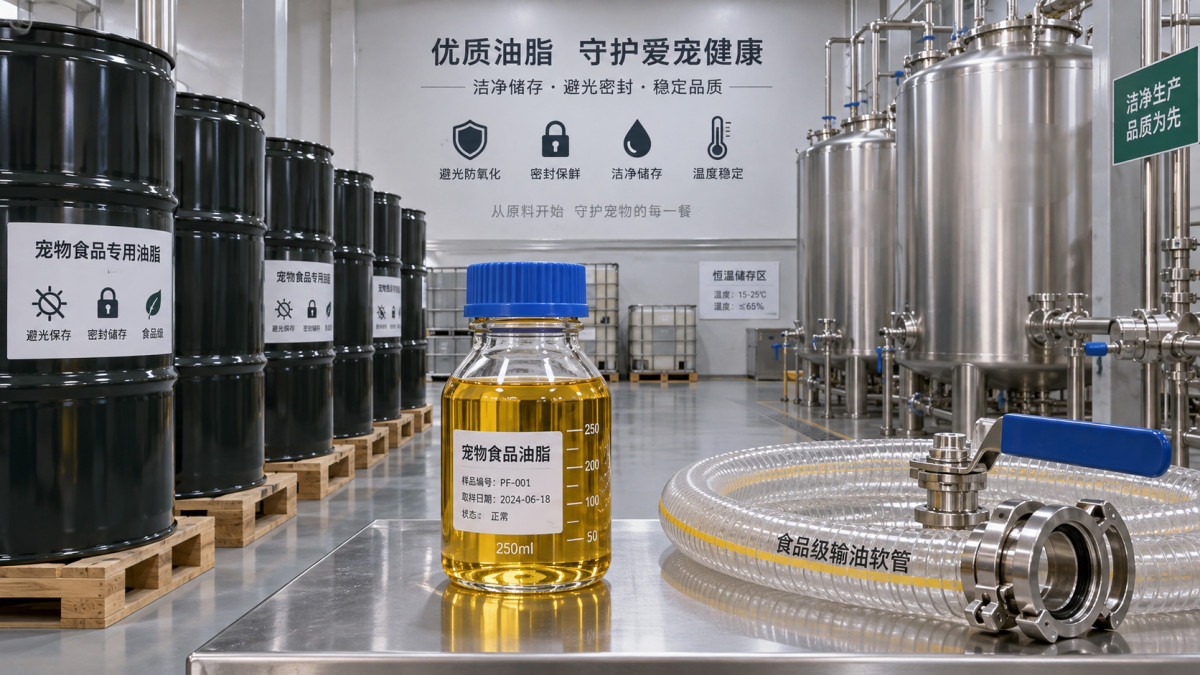
Pet food oils do not become rancid at one fixed point in storage. Oxidation begins as soon as an oil is exposed to oxygen, and it accelerates when heat, light, repeated air contact, moisture, or metal contamination are present. In a well-controlled sealed container, deterioration may remain slow. In a warm warehouse or a partly used tank with frequent opening, the same oil can develop off-odors and lose quality much sooner than expected.
The practical question is not only “How long has the oil been stored?” It is whether the storage environment has allowed oxidation to progress faster than the product can tolerate.
When rancidity risk rises during storage
Risk usually rises after a container is opened, transferred, or repeatedly drawn down. Each event can introduce fresh oxygen into the headspace and disturb settled material. Oils high in unsaturated fatty acids are generally more oxidation-sensitive, so they need tighter control than more stable fats.
Temperature is often the strongest day-to-day driver. Heat speeds up chemical reactions, while temperature cycling can create condensation and increase stress on packaging seals. Direct sunlight and strong warehouse lighting also promote oxidation, particularly in clear or poorly protected containers.
Moisture does not cause oxidative rancidity in the same way as oxygen, but water contamination can encourage hydrolytic breakdown and create conditions where quality declines more quickly. This is especially relevant around transfer hoses, tank vents, poorly dried equipment, and drums stored in humid areas.
Signs that pet food oils are moving beyond normal freshness
A strong paint-like, stale, bitter, or sharp odor is a practical warning sign, but smell alone should not be the only release decision. Early oxidation may not always be obvious, especially when oils are handled near strongly scented ingredients or when formulation odors mask the change.
Other warning signs include unexpected darkening, cloudiness that does not match the oil’s normal cold-weather behavior, sediment, foaming during handling, or a change in finished pet food palatability. These observations should trigger a hold-and-review process rather than an automatic conclusion, because appearance can also change for non-rancidity reasons.
For routine control, use retained samples and compare current material with an approved reference. Quality teams commonly combine sensory checks with laboratory oxidation testing appropriate to their internal specifications. Trending results over time is more useful than testing only when a problem is already obvious.
Storage controls that make the largest difference
- Keep the oil cool and temperature-stable. Avoid storage near boilers, sun-facing walls, loading doors, or heat-generating equipment.
- Limit oxygen exposure. Keep drums tightly closed, minimize open handling time, and avoid leaving partly empty containers in use for extended periods.
- Protect from light. Use opaque packaging or store containers away from direct sunlight and intense light sources.
- Maintain clean, dry transfer equipment. Hoses, pumps, valves, and tanks should be suitable for edible oils and fully drained before use.
- Apply first-in, first-out discipline. Older lots should be used first when they remain within approved quality limits, while opened lots require closer attention than unopened stock.
A common mistake: relying only on the supplier shelf-life date
The stated shelf life generally assumes defined packaging and reasonable storage conditions. It is not a guarantee that an oil will remain suitable after extended exposure to heat, air, or poor handling. A lot can be within its date yet be unsuitable for production if oxidation indicators or sensory assessment show deterioration.
The opposite can also be true: an oil near the end of its stated storage period is not automatically rancid if its packaging has remained intact and its quality checks remain acceptable. The release decision should reflect both the lot’s condition and its storage history.
What to check before using a questionable lot
Review whether the package was opened, how long it has been in service, whether warehouse temperatures were unusually high, and whether there was any water ingress or transfer-equipment issue. Compare the lot against retained material, assess odor and appearance under controlled conditions, and use the established analytical release criteria before blending it into a larger batch.
For pet food oils, preventing rancidity is usually more effective than trying to manage it after it appears. A documented storage routine, clean handling, and timely testing protect both oil stability and consistency in the finished product.
Related Posts
- ▶ Which pet food oils best support omega-3 claims in dog diets?
- ▶ How pet food fats affect kibble texture after extrusion
- ▶ When do pet food oils become rancid during storage?
- ▶ How to compare pet food fats and oils by energy density
- ▶ What to check when sourcing pet food ingredients with added oils
- ▶ Can coating with pet food oils improve dry food palatability?