APPLICATIONS
Reliable oil ingredients supporting pet food formulation, palatability and production needs.
How pet food fats affect kibble texture after extrusion
How Pet Food Fats Affect Kibble Texture After Extrusion
Pet Food Fats strongly influence post-extrusion kibble texture, but their effects depend on fat type, dosage, application stage, and the base formula.
For production operators, the practical goal is consistent expansion, controlled hardness, effective surface coating, and stable finished-product quality from batch to batch.
Why Fat Timing Matters During Kibble Production
Fat added before extrusion acts differently from fat applied after drying. Pre-extrusion fat changes dough lubrication, starch cooking, and expansion inside the extruder.
Higher internal fat levels can reduce friction and mechanical energy. This may lower die pressure, reduce starch gelatinization, and produce denser kibble.
When expansion falls too far, kibble can become compact, hard, and less porous. It may also require adjustments to moisture, screw speed, or barrel temperature.
Post-extrusion coating usually has less effect on internal structure. It mainly improves surface appearance, aroma release, palatability, and perceived freshness.
How Pet Food Fats Influence Crunchiness and Hardness
Kibble crunchiness depends on pore structure, moisture level, starch expansion, and wall strength. Pet Food Fats affect each factor indirectly during processing.
Moderate internal fat can support smoother processing and reduce excessive shear. However, too much fat may weaken expansion and create an overly dense bite.
Low-fat formulations often expand more easily, but they can become fragile. Operators may see more fines, breakage, and inconsistent kibble during conveying.
A well-balanced formula creates crisp kibble without making it brittle. Texture targets should be checked using bulk density, hardness testing, and visual inspection.
Surface Coating Can Change the Finished Kibble Feel
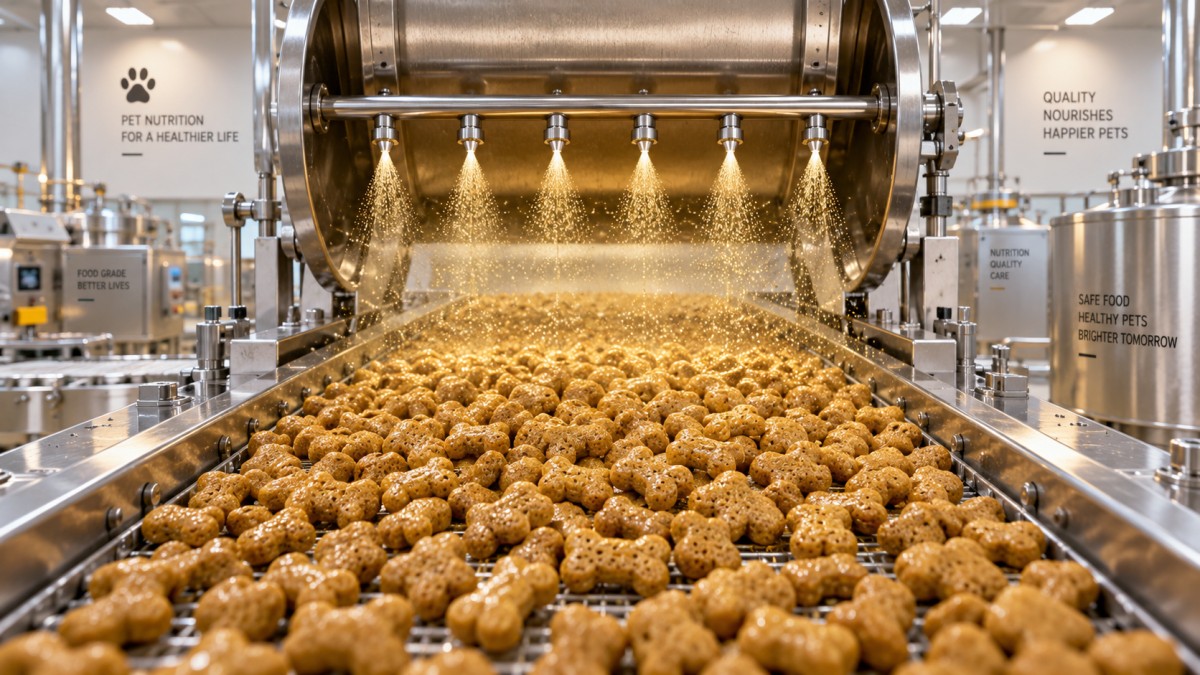
Applying fat after drying gives operators more control over surface quality. A uniform coating makes kibble look cleaner, reduces dust, and carries flavor ingredients effectively.
Insufficient coating may leave the product dry-looking and less attractive. Excessive coating can create greasy surfaces, poor bag appearance, or clumping during storage.
Coating temperature matters because fat viscosity affects spray distribution. If the fat is too cool, coverage may be uneven and nozzles may perform poorly.
Operators should monitor coating rate, drum speed, spray pressure, and product temperature. These controls help maintain consistent oil pickup across every production lot.
Choosing the Right Fat Source for Processing Stability
Different Pet Food Fats vary in melting behavior, oxidative stability, odor, and coating performance. Selecting a fat should consider both nutrition and equipment conditions.
Liquid fats generally flow and spray more easily at normal operating temperatures. They can support even coating, although oxidation control remains important during storage.
More saturated fats may offer better resistance to oxidation, but they may require heating systems. Poor temperature control can cause separation, clogging, or uneven coverage.
Quality teams should evaluate free fatty acids, peroxide value, moisture, impurities, odor, and color. Stable incoming fat quality reduces unexpected texture variation in finished kibble.
Practical Checks for Operators When Texture Changes
When kibble becomes too hard, first compare actual pre-conditioner moisture, barrel temperature, die pressure, and internal fat addition with approved process targets.
If kibble is soft or breaks easily, inspect expansion, drying performance, final moisture, and product handling. The cause may involve several process variables together.
Check coated kibble after cooling, not only immediately after spraying. Surface oil can migrate while product temperature drops, changing gloss and package feel.
Keep retain samples from each lot and compare density, hardness, coating appearance, and odor. Trend records help operators identify gradual changes before complaints occur.
Conclusion
Pet Food Fats are not simply flavor carriers. Their source, quantity, temperature, and addition point directly affect extrusion behavior, kibble texture, coating quality, and shelf stability.
For reliable results, control internal fat carefully, apply surface fat uniformly, and verify finished texture with routine measurements. Consistent fat management supports stable production and appealing kibble.
Related Posts
- ▶ Which pet food oils best support omega-3 claims in dog diets?
- ▶ How pet food fats affect kibble texture after extrusion
- ▶ When do pet food oils become rancid during storage?
- ▶ How to compare pet food fats and oils by energy density
- ▶ What to check when sourcing pet food ingredients with added oils
- ▶ Can coating with pet food oils improve dry food palatability?